Partial or total knee replacement?
If arthritis affects only one part of your knee, you may be able to choose between a partial and a total knee replacement. Both are good operations. This page compares them so that you can think about which suits you before we talk.
The difference
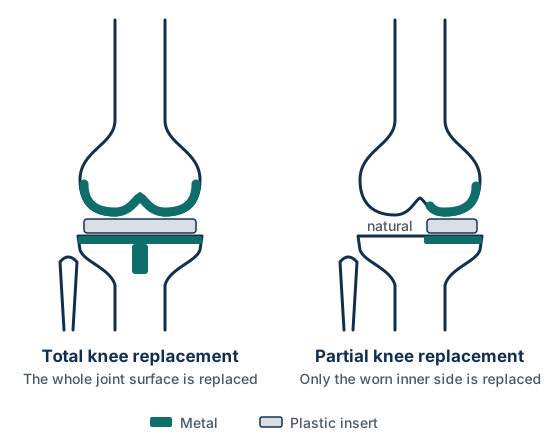
A total knee replacement resurfaces the whole joint. A partial knee replacement replaces only the worn part, most often the inner (medial) side, and keeps the healthy rest of the knee and its ligaments.
Side by side
| Partial knee | Total knee | |
|---|---|---|
| Who is suitable | Arthritis in one part of the knee, healthy ligaments, good movement | Most people with knee arthritis |
| Hospital stay | Usually 0 to 1 nights | Usually 1 to 2 nights |
| Recovery | Often quicker | Full recovery up to 12 months |
| Driving | Often after 4 to 6 weeks | Usually after about 6 weeks |
| How it feels | Often feels more like a natural knee | Most people are very satisfied |
| Serious complications in the first months | Less common | Uncommon |
| Lasting more than 15 years (implants I use) | 91 in 100 | 95 in 100 |
What the research shows
- A large UK trial (TOPKAT) found that patients did as well after a partial as after a total knee replacement at five years.
- National Joint Registry studies and a review published in the BMJ found lower risks of complications, such as blood clots, heart attack, stroke and deep infection, after a partial knee replacement.
- Partial knee replacements are more likely to need further surgery later. If that happens, a partial knee can usually be converted to a total knee replacement.
National guidance (NICE) recommends that people with arthritis in the inner part of the knee are offered the choice of either operation.
How I help you decide
I will examine your knee and review standing X-rays, and sometimes further X-rays, to see whether a partial knee replacement is possible for you. Where both are suitable, we will weigh up the quicker recovery of a partial knee against the slightly higher chance of further surgery, in the light of your age, activity and preferences. Either operation can be done with Mako robotic assistance, but I use it only where it is appropriate for you.
Written and reviewed by Mr Krishna Boddu FRCS (Tr & Orth), consultant orthopaedic surgeon, GMC 5206961. Last reviewed: 3 November 2026.
Sources
- NICE guideline NG157: Joint replacement (primary): hip, knee and shoulder (2020)
- Beard DJ et al. The clinical and cost-effectiveness of total versus partial knee replacement in patients with medial compartment osteoarthritis (TOPKAT): 5-year outcomes of a randomised controlled trial. Lancet 2019;394:746–56.
- Wilson HA et al. Patient relevant outcomes of unicompartmental versus total knee replacement: systematic review and meta-analysis. BMJ 2019;364:l352.
- Liddle AD et al. Adverse outcomes after total and unicompartmental knee replacement in 101,330 matched patients: a study of data from the National Joint Registry for England and Wales. Lancet 2014;384:1437–45.
- National Joint Registry annual reports: implant survival
- Gill JR, Nicolai P. Clinical results and 12-year survivorship of the Physica ZUK unicompartmental knee replacement. Knee 2019;26:750–8.
Book a consultation
I see patients at Nuffield Health Ipswich Hospital. You can book online, or contact my secretary, Daniela Capaldo, who can also help with insurance and self-pay questions.